|
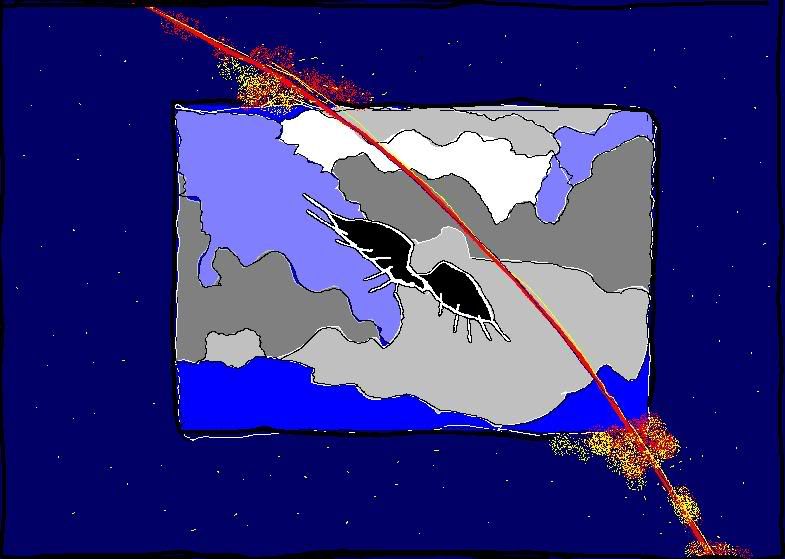
2. Setting Off As time passed Sikander grew bigger, stronger and more confident. He ventured further and further away from home, stayed away longer and longer. In those days he played exploring-games, hiding, chasing and tricking-games, which would often and easily get mixed up. With a little luck, while exploring some interesting corner of the desert, Sikander might come across one of his sisters doing the same. And with a little more luck, she might not notice, and that would make the perfect opportunity for an ambush. To make another dragon jump out of its skin seemed to Sikander one of the most amusing things there could be in life. Over months of playing and exploring Sikander became familiar with the other creatures lving in the desert, surviving thanks to shady rock-pools full of cool quiet water, hidden deep in the labyrinths of gorges and ravines which laced the three mountains. A small flock of pale grey rock-pigeons usually kept well out of the Sandragons' way for fear of being used for target practice. Ants, beetles and scorpions led hard lives of chase, work and endless conflict. Desert mice with huge ears and long tails only came out of their holes at night and kept to the shadows as they hunted for food. There were a variety of different snakes and lizards, some beautifully and brightly coloured. The lizards came in various shapes and sizes, some with spines on their backs and horns on their heads, some with great leathery ruffs about their necks, which they could flare out to frighten off their enemies. Some had long blue tongues which they could flick out like a whip to catch insects for breakfast. Some could even glide through the air from one rock to another. These last creatures spoke an old and strange dragonish dialect and even claimed to be distant relatives of the Sandragons - a notion which the dragons considered absurd, though in their hearts they knew it was partly true. Once in a while Sikander caught sight of a small slim honey-coloured man running across the blazing surface of the desert. As he ran he stooped now and then to pick up a handful of red sand here, of brown sand there, of golden, tawny or ocre sand somewhere else. Each handful went into a brown leather sack which he carried slung across one shoulder. Sikander once tried to frighten him by swooping down and blowing a fiery blast of dragon-breath across his path. But the little man had just looked up at the dragon with a broad smile, laughed sweetly, and then set off running again. That same evening Sikander asked his father about the little honey-man. The big old dragon half-smiled and said, "Oh yes. He comes and collects a little dreamdesert sand, vanishes away for a few months, then returns again. He never does us any harm and never comes by any harm from us." On the whole the family of Sandragons had little to do with the other inhabitants of the desert. Their realm was the desert sky, and there they reigned supreme - no other creature, whether bird or insect or lizard could come near them for speed, agility or range. Until, one fine day, Sikander saw something the like of which he had never seen before. He was flying far from home, playing with some puffy white clouds which were quite a rarity over the desert. Sikander found that as with mountains, there was fun to be had swooping round and between them at speed. But in some ways they were even better than mountains; he could streak underneath the clouds and dive right through them. All this was adding up to some rather fine flying, Sikander thought, when, just as he was twisting the top off an Immelmann round the peak of a tall cunim, from the corner of his eye Sikander noticed a dark distant speck flying towards him. He banked sharply round and with powerful wing-beats shot towards the mysterious speck. As he came nearer he saw that it was a bird, but quite different to any he had seen before. It was at least four or five times the size of the rock-pigeons, with a serious-looking hooked beak, wings like a pair of sabres and piercing eyes which seemed to have seen him long before he had noticed their owner. As the Sandragon drew nearer, another difference to the rock-pigeons became apparent: this one was not afraid. When Sikander tried to dive onto it, a manouever which usually scattered the pigeons like leaves before the wind, this one simply dipped a wing, letting the Sandragon slip harmlessly past, then swooped down after him. An aerial duel began in which the two creatures each tried to catch or hit the other, but there was no winner. In the end Sikander swooped down to the desert and landed on the crest of a great dune to recover his breath. His opponent glided down and settled on the sand a safe distance away. Sikander over looked at the bird. It was entirely black but for its eyes, beak and talons, which were all shining silver. It had a noble look, but not very friendly. He seemed old and tired, but a hard one, unbent by age. "Who are you?" breathed the Sandragon through a tongue of blue flame. "I am Omber Shadowhawk." replied the dark one in a cracked voice. It meant nothing at all to Sikander and only made him more curious still: "Where do you come from, and why are you here?" "I am looking for help for my cousin, the Phoenix. And by the look of it, I may have just found some." Under the sun, in the middle of the empty desert, the two creatures began a conversation which was soon to change the course of Sikander's life. Omber explained that the Phoenix was not in point of fact his cousin at all, but rather a dear friend, only distantly related. "The Phoenix," he said, "is a magnificent bird. It's feathers are all the colours of the sun and flames. It lives a thousand years and more, then towards the end of its life it builds a great pile of wood like a nest, using one bough from each of five hundred different kinds of tree. When the nest is built the Phoenix settles down upon it and ends its life there in a huge fire. For three days and three nights it burns and when at last the flames die down, a small black worm appears in the ashes. As the embers cool that worm changes into a young Phoenix, strong and glorious as ever a Phoenix was before." The Shadowhawk stopped, looked around and drew breath. "But, there is one vital matter about which no Phoenix can ever know, yet without which no Phoenix can ever be born again." "And what is that?" asked Sikander, spellbound by this strange story and more curious than ever. "It is the matter of starting the fire." "Fire?" the Sandragon laughed and blew a humming blast of blue flame across the sand, scorching a streak of it into molten blackish glass. "I knew I could count on your help." said the Shadowhawk. Without any kind of a good-bye or farewell the Shadowhawk spread his wings, leaned forward and swooped down the face of the sand-dune, then soared away into the sky, heading fast away into the west. Sikander could have caught up with him, but thought that if Omber had left so suddenly, without giving any hint of where or when the Phoenix might be found, then it must mean that the hawk either could not or would not give answers to those questions. The encounter planted a seed in the Sandragon's mind which did not bear fruit at once. For a while Sikander went back to his usual and familiar life, playing, exploring, chasing and hiding. But after a time his games began to seem pointless and he began to lose interest in the animals and landscapes of the desert. The idea of the magnificent Phoenix, building his own funeral pyre and death, and at the same time building his own future rebirth and life, became more and more fascinating to the Sandragon. That the Phoenix's life might end in misery, with no hope for the future, rather than in a blaze of glory with the certainty of new life, seemed a great pity to Sikander. That all this might depend upon him, upon his own fire, as the Shadowhawk had implied, became unbearable to Sikander. So it was that he came to the idea of searching for the Phoenix, of helping to keep alive the very spark of life for the wonderful bird. The idea grew into a decision and one fine morning he told his family that he was setting off to look for the friend of a stranger and had no idea when he would be home again. Then he slipped out onto the ledge and looked out for one last time at the familiar cliffs and crags, out across the sea of sand dunes. For a moment he wondered whether he was not making a mistake, whether he might not do better to let the Phoenix take care of itself. But then he took a deep breath and leapt off the ledge into the air, climbed up above the desert and set off southwards.
|